


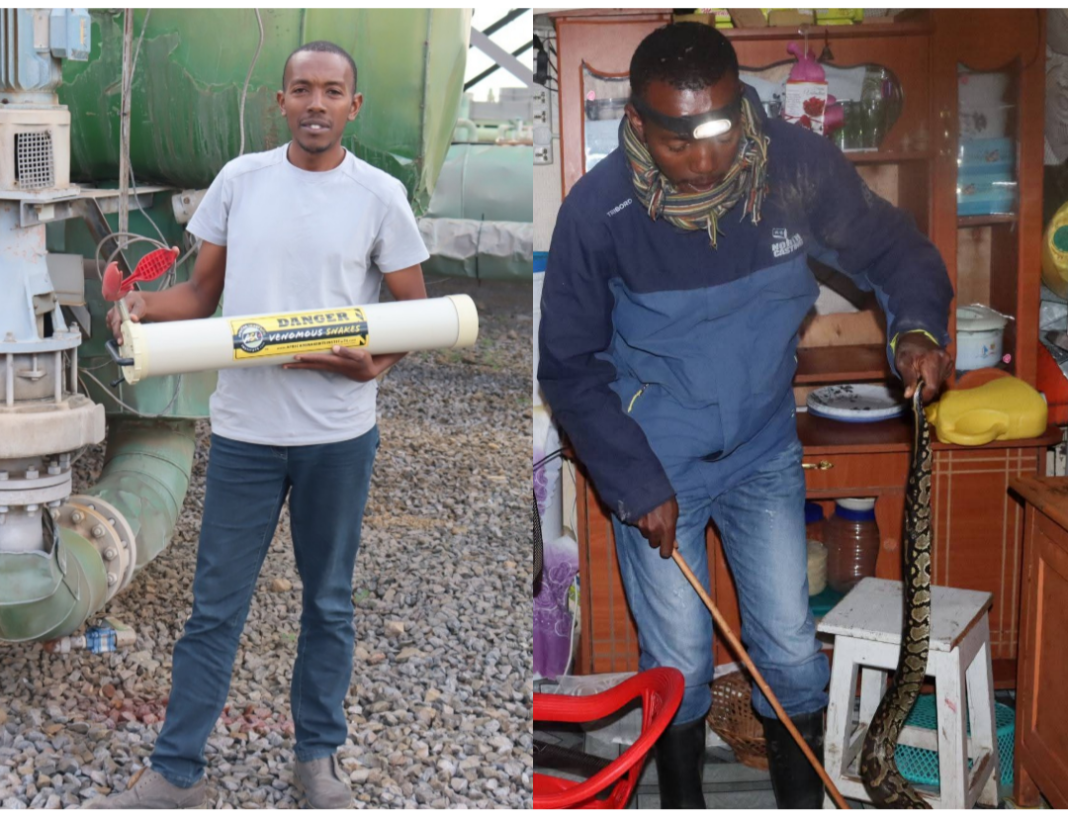

In a recent video doing rounds on the blogosphere, Stephen Githenya put up a brave rescue when he was called to rescue a huge venomous spitting cobra that measured more than 6 feet. Despite the snake spreading its hood and spitting at his face, Githenya maintained his composure and picked it up using the tongs before relocating it.
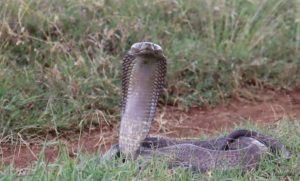
WoK has a brief chat with Githenya and brings this story of bravery in the jungle.
Wok: Hello Stephen, kindly introduce yourself and what you do.
SG: My name is Stephen Githenya, working at Soysambu Conservancy as a Naturalist.My classification is Wildlife Management and Animal Health. I’m a member of the Snake Community Action Now, a registered association with a mission of reducing snakebites by 50% by 2030.
WoK: What is your educational background?
SG: I did a Diploma in Wildlife Management at Amboseli Institute I’m Thika and then I joined the Kenya YMCA College of Agriculture and Technology for a Certificate course in Animal Health and Production which saw me registered as a Veterinary Para-professional.
WoK: Talking about snakes, I recently saw a video of you safely handling and relocating a cobra. It seemed a chilling encounter. Take us through that experience.
SG: That was my first relocation of a Large Brown Spitting Cobra (Naja ashei). It’s a spitting Cobra, the largest species we have in Kenya. It can spit and bite and has a cytotoxic venom(destroys cells).
I knew I would get venom spray from the species, safety goggles came in handy.It was a tricky rescue considering the snake had sought refuge in an old Warthog hole with other small holes near the main one.
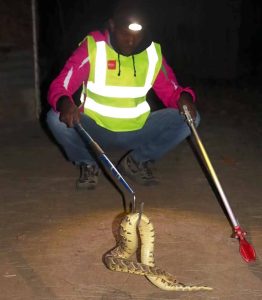
As soon as I arrived, I was directed to the exact hole the Cobra was. Snakes are good at detecting a vibration, I approached slowly with minimal force on the ground.I saw a a section of it’s body outside the hole and from that I knew it was a huge Cobra. About 6+ft long.
I was calm and happy to see the snake. At times you get a call and you are not guaranteed to catch them.I moved away to get my tools ready for the capture.
After a short while I got ready and went back to catch only to find it missing. It had already gone into the hole.The mission of the day was simple; catch the cobra safely and relocate it within Mugie Conservancy.
I had to come up with a quick strategy to ensure I succeeded to capture the Cobra safely. Safety First on myself.I stood approximately 10m away from the hole with hope that the snake would come out to bask.You have to be patient.
After 1 hour and 45 minutes, I saw the head of the Cobra come out first and then a long body followed. I approached slowly and with my snake tongs I held the snake and moved it away from the hole.
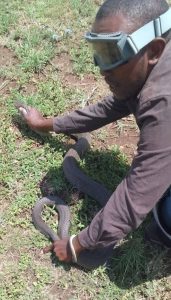
The snake was very upset, it reared it’s upper body and spread it’s hood, spat at my face.It’s a spectacular thing to see the hood spread. With great composure I went ahead, necked the snake and bagged it. Not my preference due to the risk of getting bitten but some situations take me to hands on handling.
Wok: Is the spitting cobra the most difficult to handle?
SG: No. I’d say arboreal snakes from experience. Boomslangs will move from one tree branch to another at lightning speed. With the spitting cobra, the risk is getting bitten and venom in the eyes if they spit at you.
WoK: What criteria do you use to select the point of relocation considering snakes can still slither back to the community?
SG: Habitat: it’s always good to release them to a habitat that is in their distribution
Human settlements: releases are best done away from human settlements.
Distance: snakes can still find their way back to an area they are familiar with. It’s good to release them far away from the point of capture.
WoK: Do you charge in case someone calls to have a snake removed from their house/compound?
SG: Yes I do. However, I do some rescues for free. I’m happy to get a fee to cover my transport and get medical insurance.
WoK: How much do you charge?
SG: That depends on distance covered, transport and time taken. I am sorry I have not set my charges.
WoK: Great. Where do you source your handling equipment like tongs and goggles?
SG: I made a hook recently. All other equipment have been donated by friends. I can’t thank them enough.
WoK: What do people perceive about your career? Are there any stereotypes?
SG: I’ve had positive and negative perception about what I do but majority appreciate what I do.
WoK: Are you just confined around Naivasha area?
SG: No. I can go anywhere to save snakes and prevent snakebites to people and animals. Kenya has 15,000 annual snakebite cases. With this in my mind, I have to do something.
WoK: What should people do to prevent snakebites?
SG: Information is power. Most people fear snakes. Here are prevention strategies:
1. Clearance of vegetation around houses. Tall grasses act as good grounds for hunting and hiding.
2. Wear closed shoes at night. Some snakes are nocturnal and can easily bite in self defense when you step in them.
3. Use a torch at night -makes paths visible at night
4. Construct poultry houses away from the main house – poultry and eggs are food sources for snakes
5. Avoid putting hands in tree holes when someone is working outdoors
6. Avoid sleeping on the floor
7. Avoid leaving shoes outside; check before putting them on .
8. Don’t handle snakes if you don’t have proper knowledge
9. Don’t pick dead snakes- snakes can still envenomate if the fangs punctures the skin
10. Move away from snakes when you encounter them and call for a snake handler.
WoK: Thanks. How many snakes have you rescued so far? Which venomous species is the most common around Naivasha area?
SG: About 35 snakes. (For the most venomous) We have the Egyptian Cobra. It Has a neurotoxic venom. However, there are other venomous snakes such as the Puff Adder, Boomslang, Black-necked Spitting Cobra,Mole Viper.
WoK: Could you also take us through the challenges you face?
SG: Financial constraints to conduct training and snakebite risk when handling snakes.
Wok: Finally, what are the your future plans?
SG: My plans are to reduce snakebites and conserve snakes. Additionally, I intend to raise awareness through education about snakes and snakebites, providing prevention of snakebites and first aid and safe relocation of snakes from homes and workplaces when need arises.
This is the mission I carry high as a member of the Snake Community Action Now. My personal future plans would be to get a small 4*4 car to facilitate quick response and cover big area.
WoK: Thanks for your time and good luck.
SG: Anytime.
Stephen Githenya can be contacted on:
+254 723053845