


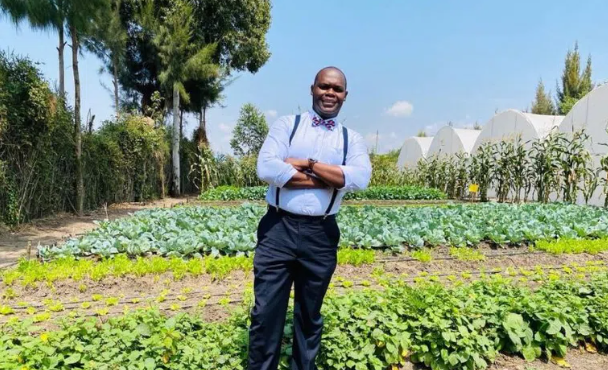

Noah Nasiali is one of the most recognizable agripreneurs in Kenya, and perhaps the wider East Africa.
He is the CEO and founder of Afarmers Media and is credited with building one of Africa’s most engaged online farming communities.
In a recent interview on The Organic Guy Podcast, Noah shared the successes and failures he has experienced during his long career in agribusiness.
This is his story as told by WoK:
Avoiding brokers
Like many Kenyan farmers, Noah woke up one day and decided that enough was enough.
He would no longer grovel or be at the mercy of brokers, come what may. He would sell his produce directly to consumers.
That year, Noah was fortunate enough to harvest 14 tonnes of watermelons.
“Fourteen tonnes is a lot of watermelons. We harvested them for a whole day,” he recalled.
After harvest, Noah hired a truck and transported them to City Park Market in Nairobi. He had already agreed to sell them to a buyer for KSh 45 per kilogram.
“At that price, I knew I would get a good return. My plan was to buy a brand-new vehicle with the money I got from selling the watermelons,” he said.
Little did he know that he was in for a surprise.
Collapse of the deal
Within an hour of arriving at City Park, Noah had come to the unsettling realization that he was in the wrong market. The sea was teeming with bigger fish.
The buyer informed him that another truck had just delivered a container of watermelons from Uganda. Those watermelons were selling for only KSh 12 per kilogram.
His offer was for Noah to either reduce his price to ksh 25 per kilo, or find another buyer.
Surprised, Noah reminded the buyer to honour their initial agreement, but the guy was adamant that he would not pay a cent more than sh 25 per kilo.
With a sinking feeling, Noah decided to go back to his truck and try vending his wares elsewhere.
Becoming a hawker
Noah travelled to Makadara, Thika, Murang’a and several other places, trying to sell the watermelons. But all his efforts hit a brick wall.
“I went everywhere. But I still could not finish selling the melons,” he recounted.
He then decided that he would find a place to store the watermelons and release the truck so that the driver could go for other duties.
He found a store, spread a layer of sawdust on the floor, piled the watermelons on the sawdust, and locked the door, resolving that he would continue selling them the next day.
Strange Noises
At around 3 am, the security guard whom Noah had hired to guard the store called him, saying that he was hearing some strange noises within the building and asking if Noah had mistakenly locked someone inside.
Puzzled, Noah replied no and said that he was positive that he had locked the door.
“The security guard insisted that he could hear some unusual movement inside the store. However, since my residence was about 70 km away, I decided that the matter could wait until the next day,” said Noah.
At 6 a.m., Noah returned.
The security guard informed him that he suspected that someone had broken into the store overnight and had been crushed by the melons.
Fearing the worst, Noah and the security guard opened the door. The sight that greeted them was one that remains imprinted in Noah’s memory to this day.
All the melons had burst.
According to Noah, several conditions inside the store caused the disaster.
The watermelons had been harvested during the heat of the day and contained plenty of natural sugar. The store was poorly ventilated. The sawdust was the final straw, creating the perfect conditions for fermentation.
“The noise the security guard had heard was that of the watermelons bursting,” narrated Noah, shoulders shaking with laughter as he recounted the event.
Mercifully, he recovered from the loss and later succeeded in several other agribusiness ventures, and he now tells the story as a cautionary lesson for other farmers.