


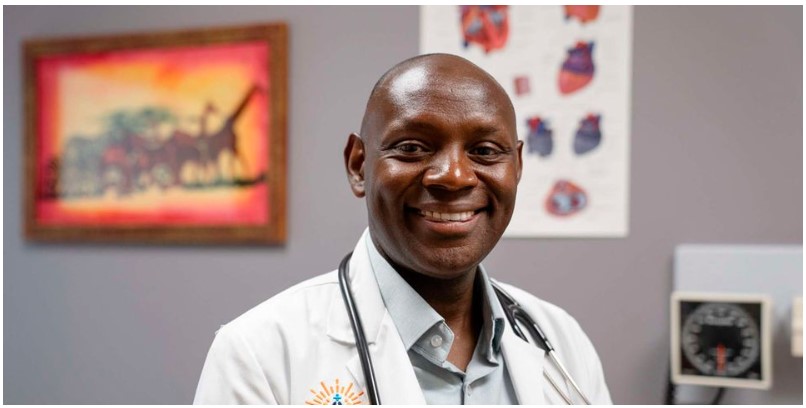

Kagaa is a village of about 2000 residents located in Olkalou, Nyandarua County.
This is where Geoffrey Mwangi grew up, and where his ambitions of becoming a doctor were born.
After sitting for his KCSE in 2000, he did what many of his age mates at the time were doing. He waited.
But rather than sitting idly, he sought scholarships, writing letters to countless universities abroad seeking scholarships.
One of his letters was accepted, and Mwangi received a scholarship invitation from the University of Wisconsin in Green Bay, US.
Coincidentally, the Kenyan medical school also offered him a chance to study medicine, but he chose the aeroplane.
“I wanted to become a doctor and help people,” he told Nation. “I knew a long journey starts with the first step, which was in motion,”
In 2006, he graduated with a biology degree, and by 2010, he had completed nursing school in Wisconsin and had landed a job as a nurse at Salem Hospital.
In 2013, he completed his master’s degree and, a year later, completed his Doctor of Nursing Practice (DNP), both from Oregon Health and Science University.
In the US, the DNP is the highest accolade of the nursing profession, which lets nurses open their own independent practices in states such as Washington.
It allows nurses to examine, diagnose, test, and manage sudden and chronic diseases.
Armed with his credentials, Mwangi relocated to Spokane, Washington, i
4 and joined a local clinic, where he worked for more than 10 years.
The 10 years helped him identify the glaring healthcare market gap that existed in Washington.
Consequently, in July 2024, at the West Central Community Center in Spokane, he opened his own medical practice called Asante Health Clinic.
The clinic serves patients of different demographics, including children, women, and the elderly.
It also offers telehealth, nutrition support, and mental health treatment.
However, while the clinic has been successful, Mwangi said that he has had his fair share of challenges.
“If I knew then what I know now, I would have thought much more carefully before opening a clinic,” he said.
One of the main challenges he has encountered is that of managing paperwork.
According to Mwangi, credentialing and contracting with insurance companies in America can be a tedious process and can take years.
During his first year of operation, Mwangi stated that he treated patients while receiving very little compensation from insurance companies.
Some of the plans had not been resolved even during the clinic’s second year of operations.
“I hope there will be meaningful reforms to simplify the credentialing process for new healthcare providers and small practices,” he said, adding that patients from underserved communities suffer the most.
Despite these challenges, Asante Health Clinic has kept growing, serving 10 to 15 patients per day.
Each patient is assigned 30 to 60 minutes, a luxury that many American clinics cannot provide.
Many of Mwangi’s patients speak Swahili, and the shared language enables him to come up with care plans that suit his patients.
” Patients ask where I am from. I tell them Kenya. Many respond by saying, ‘We are so lucky to have you in the United States, ’ he said.
Back home, Mwangi has been running mission work in rural Kenya since 2010. Purity, his wife, who owns several adult family homes, travels with him on these missions.
His advice to medical students in Kenya is for them to keep believing in themselves and that the American Dream is real.