Radio Generation Kenya Owner: Meet The Man Behind The Station And His Other Business Interests

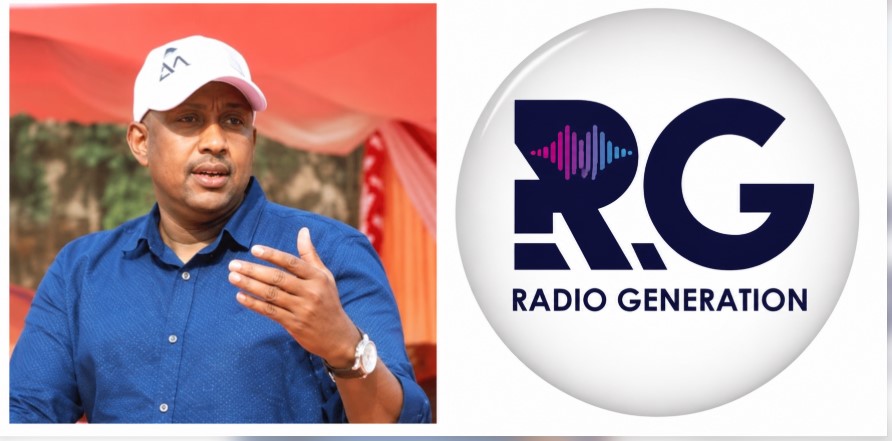
Since making its debut on the Kenyan airwaves in July 2025, Radio Generation Kenya (RGK) has been on what can be described as an upward trajectory.
The media house is linked to Ahmed Mohamed Asmali, popularly known as the “Mayor of Eastleigh”.
Asmali is the founder of Sharp Generation Media Limited, the company that operates Radio Generation.
The businessman, who is a leading figure in Eastleigh’s business community, has also been involved in the establishment of The Eastleigh Voice newspaper
Radio Generation operates from George Padmore Ridge along George Padmore Road in Nairobi.
Long before establishing himself in Kenya’s broadcasting industry, Asmali was a prominent figure in Eastleigh’s business community.
He used his social media influence to campaign for better roads, improved drainage and sanitation services in Eastleigh.
Among his campaigns was #EastleighNeglected, which sought to draw the Nairobi County Government’s attention to the poor state of infrastructure in the area.
He was also behind #EastleighShutdown, during which businesses closed for three days.
They were protesting against street hawking that traders said was blocking customers from accessing their premises.
Asmali also runs a company called Asmali Media. The firm’s services include public relations, communications, advertising and events management.
Some of the events that the company has organized have sought to promote Eastleigh as a regional business and investment destination.
The radio broadcasting industry in Kenya
Asmali entered Kenya’s radio broadcasting industry at a time when competition for listeners and advertising revenue has been at a historic high.
The Communications Authority of Kenya (CAK) estimates that Kenya has about 330 licensed FM radio services. These include 227 commercial, 88 community and 15 public radio services.
Radio has undoubtedly faced stiff competition from social media, podcasts, and other digital platforms. However, it still remains one of Kenya’s most widely consumed forms of media.
Among the prominent businessmen who have invested in the industry is Samuel Kamau Macharia, popularly known as S.K. Macharia, who established Royal Media Services in 1996.
His media company operates Radio Citizen alongside several vernacular radio stations, including Inooro FM, Ramogi FM, Musyi FM and Egesa FM.
Mount Kenya University founder Prof. Simon Gicharu also ventured into broadcasting through Cape Media Limited, the company behind TV47 and Radio 47.
Other entrepreneurs who have invested in the sector include Patrick Quarcoo and William Pike, who established Radio Africa Group in 2000.
Radio Africa operates Kiss FM, Classic 105, Radio Jambo, Homeboyz Radio and other broadcasting platforms.
Despite being in operation for less than two years, Radio Generation has proven itself as a force to reckon with.
Part of its expansion strategy has involved recruiting experienced broadcasters from established media houses.
On July 29, 2025, the station announced the arrival of veteran radio presenter CT Muga, who had spent nearly six years hosting The Situation Room on Standard Group’s Spice FM.
Muga joined Mung’ala Mbuvi on The People’s Breakfast, the station’s flagship morning programme.
In August 2026, Radio Generation added another veteran broadcaster, John Karani, whose broadcasting career has taken him to radio stations in Kenya and Tanzania.
The media house has also ventured into audio-visual broadcasting, allowing audiences to watch interviews live on YouTube and Facebook.
Viewers and listeners can also access shorter clips through Instagram and TikTok.
In a past interview, Radio Generation’s Head of Radio, Brian Evusa, explained that technological changes were transforming how audiences consume radio content.
“With the shift to audio-visual broadcasting, radio has become a multi-platform experience,” Evusa said.