How Kenyan Businesses Make Up To Ksh 15 Million Supplying Campaign Vehicles, Merchandise, And Branding To Politicians

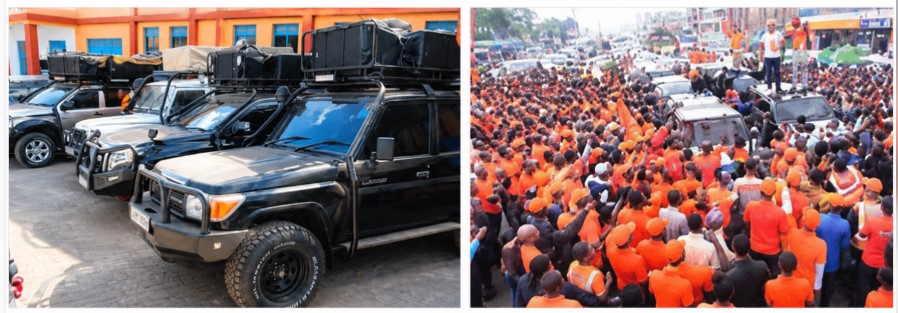
As Kenya’s election campaign season gathers momentum ahead of the August 2027 general elections, some entrepreneurs are minting millions, as they have in previous election years.
For some businesses, one campaign contract can rake in more revenue than the business would have made from several months of normal operations.
In this article, WoK features some of the ways that Kenyan businesses make money during campaign seasons:
Campaign Sound Systems
Kennedy Ndwiga, the entrepreneur behind Spectrum Audio Systems Limited, is among the businesspeople benefiting from politicians’ demand for powerful campaign sound systems.
His business is based in Kasarani. There, he mounts public address systems on ordinary private vehicles for politicians.
Ndwiga charges between ksh 400,000 and KSh 700,000 to equip Toyota Proboxes and Subarus.
For larger vehicles like Toyota Prados, Land Cruisers and Pajeros, he charges between KSh 850,000 and KSh 2.5 million.
A ksh 1.4 million installation can serve crowds of 2000 to 5000 people, while premium systems that cost ksh 2.5 million can reach gatherings of up to 7,000 people.
He estimates that his business modified between 100 and 150 vehicles during the 2022 General Election.
Ndwiga’s workshop has employed 23 workers as well as 12 other casual employees. He also has customers in Uganda, Tanzania and South Sudan.
Aside from Ndwiga, Patrick Nderitu is another entrepreneur who has benefited from this line of business.
During the 2022 presidential campaign, Nderitu was involved in ‘pimping’ William Ruto’s six-wheeled campaign truck through his company, called Pimp My Ride.
The vehicle, valued at between KSh 80 million and KSh 100 million, was imported from Dubai.
It had a red-carpeted interior, refrigerator, charging ports, sunroofs, a VIP protection area, and a podium for addressing supporters.
Campaign caps
Selling political merchandise is another way that Kenyan businesses are making money.
Samuel Mwangi, who runs a printing business along Kilome Road in Nairobi, is one of the entrepreneurs who have benefited.
When Mining CS Hassan Joho was campaigning to become the governor of Mombasa County, he contracted Mwangi to produce 20,000 branded caps.
For each cap, Mwangi charged ksh 100 as well as an additional ksh 40 branding fee.
From the order, he generated ksh 2.8 million in revenue, which was what his business would have ordinarily made in two months.
His shop has also received campaign merchandise orders from Margaret Wanjiru and Kiraitu Murungi.
Wanjiru ordered 5,000 branded keyholders, while Kiraitu ordered 6,000. The combined orders were worth approximately KSh 500,000.
Hiring campain trucks
Another way that entrepreneurs mint millions during campain seasons is by hiring out roadshow trucks.
These trucks are usually equipped with speakers, microphones, and platforms for addressing supporters.
During the 2013 elections, Business Daily reported that politicians paid up to KSh 150,000 daily to hire campaign trucks within Nairobi.
The trucks came with a driver and DJ. For campaigns outside Nairobi, an additional ksh 50,000 fee was imposed.
This means that a truck hired for 20 days would generate about KSh 3 million in gross revenue.
Political branding
Another entrepreneur that has made money by targeting Kenya’s campaign season is Luna Graphics, a Nairobi-based printing and branding business.
In 2022’s elections, the company reportedly handled a campain contract that was worth over ksh 15 million.
The project involved producing campaign materials for distribution across Kenya’s 47 counties.
The order included 500,000 posters, 50,000 banners, 200,000 branded T-shirts and one million flyers.
Displaying Political Posters
Even ordinary matatu operators have benefited from political campaigns.
During the 2022 elections, politicians in Kiambu County paid matatu operators approximately KSh 2,000 every week to display their posters.
According to The Standard, Peter Wainaina, who operated four matatus, earned KSh 8,000 weekly from the arrangement.
Politicians preferred matatus because they travelled through markets, towns and residential areas, which was where many of the voters were.