



Kenya’s rich cultural diversity is reflected in its extensive culinary traditions, particularly in the prominence of fermented milk products, which are highly valued among various ethnic groups.
Among the most distinguished of these products are ‘maruranu,’ originating from the Kisii and Kuria communities, and ‘mursik,’ associated with the Kalenjin community.
Both of these fermented milk products play significant roles in the diet and culture of their respective communities, yet they differ markedly in their preparation methods, flavors, and cultural importance.
Maruranu is a traditional fermented milk product hailing from the Kisii and Kuria communities in western Kenya.
This delicacy is renowned not only for its distinctive flavor but also for its health benefits and cultural relevance.
The preparation of maruranu involves a careful process that starts with the collection of fresh cow’s milk.
The milk is boiled to eliminate any harmful bacteria and then cooled.
After cooling, it is transferred to a specific container where fermentation occurs. Notably, no additives or herbs are introduced at any stage of the fermentation process.
This fermentation can take several days, during which the milk thickens and acquires a mildly tangy flavor.
Mursik is a celebrated fermented milk product within the Kalenjin community, located in Kenya’s Rift Valley region.
It is distinguished by its unique appearance and flavor, reflecting a deep cultural heritage.
The process of making mursik begins with fresh cow’s milk, which is boiled and subsequently allowed to cool.
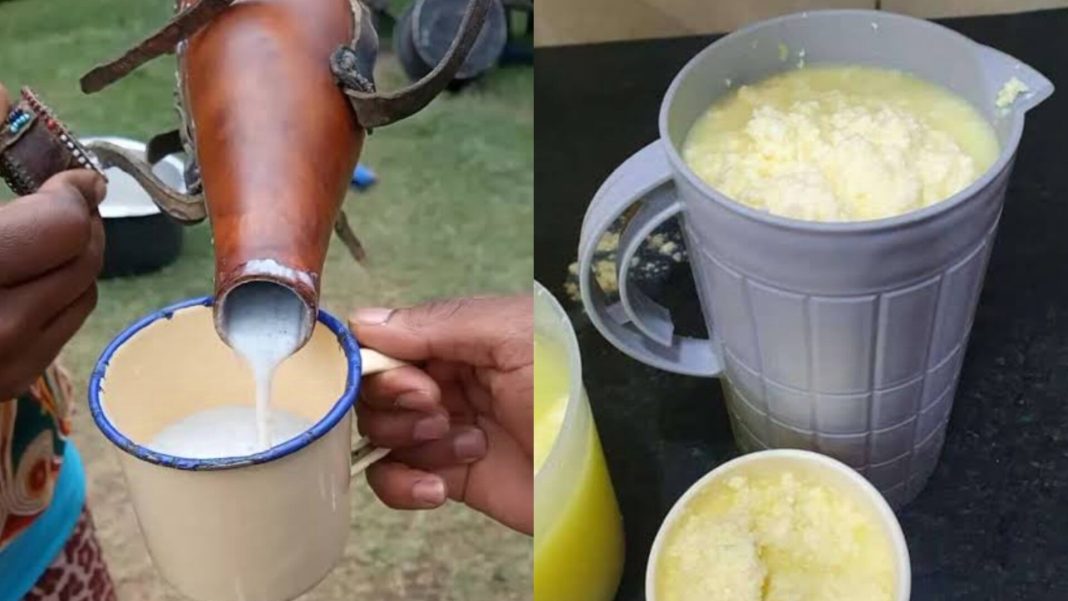
Once cooled, the milk is poured into a ‘sotet,’ a traditional gourd specifically designed for this purpose.
Prior to adding the milk, the gourd is treated by smoking it with particular herbs and branches, such as ‘senetwet’ (Solanum incanum), which not only enhances the flavor but also serves as a natural preservative.
The fermentation of mursik generally takes several days, during which the milk transforms, acquiring a rich, tangy flavor and a thick texture.
The inclusion of charcoal from the smoked herbs contributes to mursik’s distinctive speckled appearance and slightly gritty feel.
Although both maruranu and mursik are important fermented milk products within their respective cultures, they exhibit several differences, particularly in flavor.
Maruranu possesses a delicate flavor that arises from its fermentation process, whereas mursik exhibits a stronger herbal and smoky profile, attributed to the particular herbs utilized during the smoking of the gourd.
In terms of appearance, mursik typically displays a speckled look resulting from the charcoal of the smoked herbs, while maruranu retains a more consistent, creamy texture.
The fermentation techniques, including the types of containers and smoking methods employed, vary significantly, leading to the distinct tastes and textures characteristic of each product.