


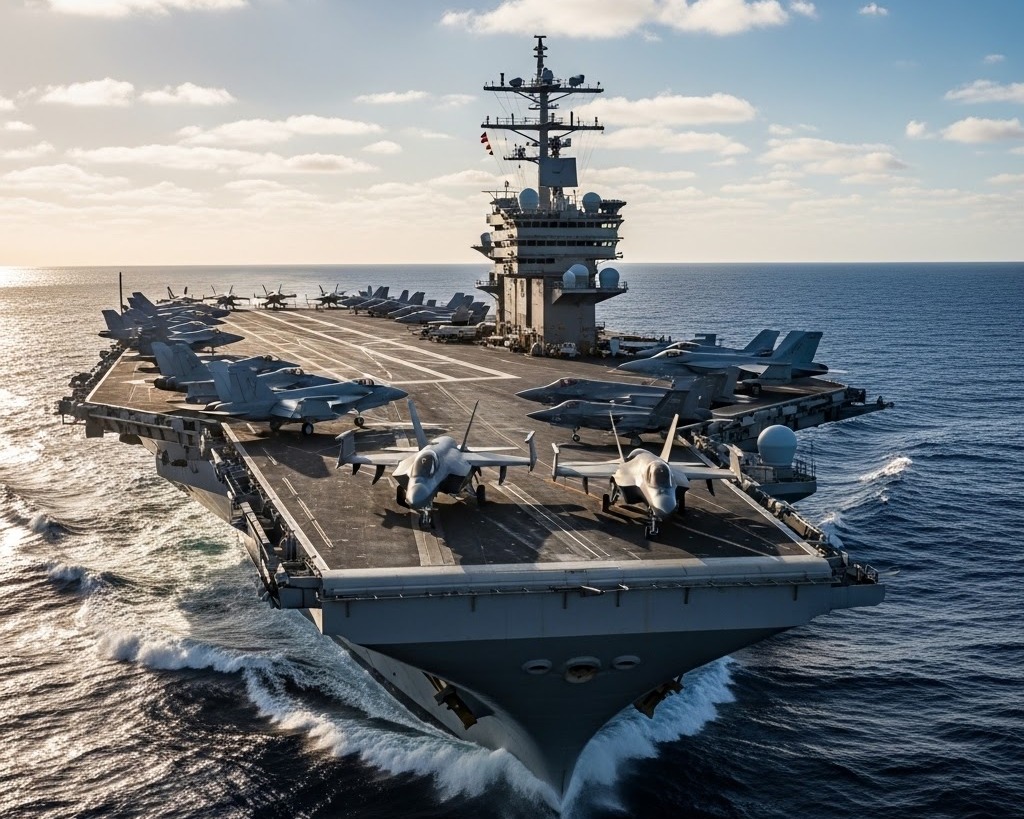

While we are out here having heated debates about the national debt and the cost of living, the United States Navy casually has a Ksh 1.7 trillion city just floating somewhere in the middle of the ocean.
Meet the USS Gerald R. Ford. It’s an aircraft carrier the size of three football fields, packed with 75 fighter jets and capable of wiping out targets thousands of miles away. But forget the heavy artillery for a second—how on earth do you house, feed, and clean 5,000 sailors on a ship that doesn’t touch land for months?
Just How Much is Ksh 1.7 Trillion in Kenya?
To put the Ksh 1.7 trillion ($13 billion) cost of the USS Gerald R. Ford into perspective, this single military vessel is an absolute economic behemoth. In a Kenyan context, Ksh 1.7 trillion could:
Easily fund 40% of the National Budget
Kenya’s projected national budget for the 2025/2026 fiscal year is roughly Ksh 4.3 trillion. Of this amount Ksh 3.09 trillion is for recurrent expenditure and Ksh 725.1 billion for development.The cost of this one ship could fund almost half of the country’s entire operations for a year.
Build an additional 19 Nairobi Expressways
The 27-kilometer Nairobi Expressway cost roughly Ksh 86 billion. For the price of the aircraft carrier, Kenya could build nearly 20 of those superhighways.
Construct 4 Standard Gauge Railways (SGR)
The Mombasa-Nairobi SGR project cost approximately Ksh 416 billion (in today’s USD terms). Ksh 1.7 trillion is enough to build four of them from scratch.
Here is a look inside the daily life of the sailors operating this trillion-shilling titan.
Feeding a City: A Ksh 8.4 Million Daily Grocery Bill
Floating in the middle of the ocean means you can’t just step out to the local supermarket. The logistics behind keeping the crew fed are staggering:
A team of highly trained culinary specialists serves up to 17,300 meals every single day, keeping the kitchens running 24/7. In just one day, the crew consumes 1,600 lbs of chicken, 350 lbs of lettuce, and brews 20,000 cups of coffee.
The grocery bill alone costs the US Navy between Ksh 5.85 million ($45,000) and Ksh 8.45 million ($65,000) per day—over Ksh 130 million ($1 million) a month. Every 7 to 10 days, massive supply ships pull alongside the moving carrier to transfer hundreds of thousands of pounds of food via cable systems.
Sleeping in “Steel Coffins”
Forget about personal space or plush mattresses. Space is an absolute premium on an aircraft carrier. Sailors sleep in cramped compartments where beds, known as “racks”, are stacked three people high. A standard rack is slightly smaller than a twin bed.
The most shocking part? From the top of the thin foam mattress to the bottom of the rack above, there is only 20 inches of clearance. It’s barely enough room to roll over, which is why sailors in the lower bunks affectionately call them “coffin lockers.”
The Ksh 52 Million Toilet Problem and “Navy Showers”
Staying clean in a vessel shared with 5,000 other sweating humans is heavily enforced to prevent disease outbreaks, but it comes with unique challenges. A typical enlisted birthing area has three to four showers and toilets shared by 80 to 100 people. On the newest Ford-class carriers, all bathrooms are completely gender-neutral, meaning there are no urinals at all.
The ship uses a vacuum-powered septic system similar to an airplane. Because sailors sometimes flush unauthorized items, the pipes frequently clog. To clear a serious blockage, the Navy has to perform a chemical “acid flush” that costs an eye-watering Ksh 52 million ($400,000) every single time.
Fresh water is a precious resource. Sailors take a “Navy Shower”—you turn on the water to get wet, turn it off to lather up with soap, and turn it back on to rinse. This method uses just 3 gallons (11 liters) of water, compared to a typical civilian shower that guzzles up to 60 gallons.
Laundry Room
Doing laundry on a ship this massive is an extreme sport. The laundry facilities process a staggering 150,000 pounds of laundry every single week.
The machines are housed deep below the waterline, where temperatures regularly exceed 135°F (57°C). Because of the intense heat, sailors are often limited to working one-hour shifts just to avoid heatstroke.
It might not be a luxurious life, but the amenities have heavily improved over the decades, with newer ships offering Wi-Fi lounges, gyms, post offices, and relatively better food. It takes immense mental toughness to adapt to the constant noise, artificial light, and cramped quarters, but it’s what keeps one of the world’s most powerful military forces operational.