


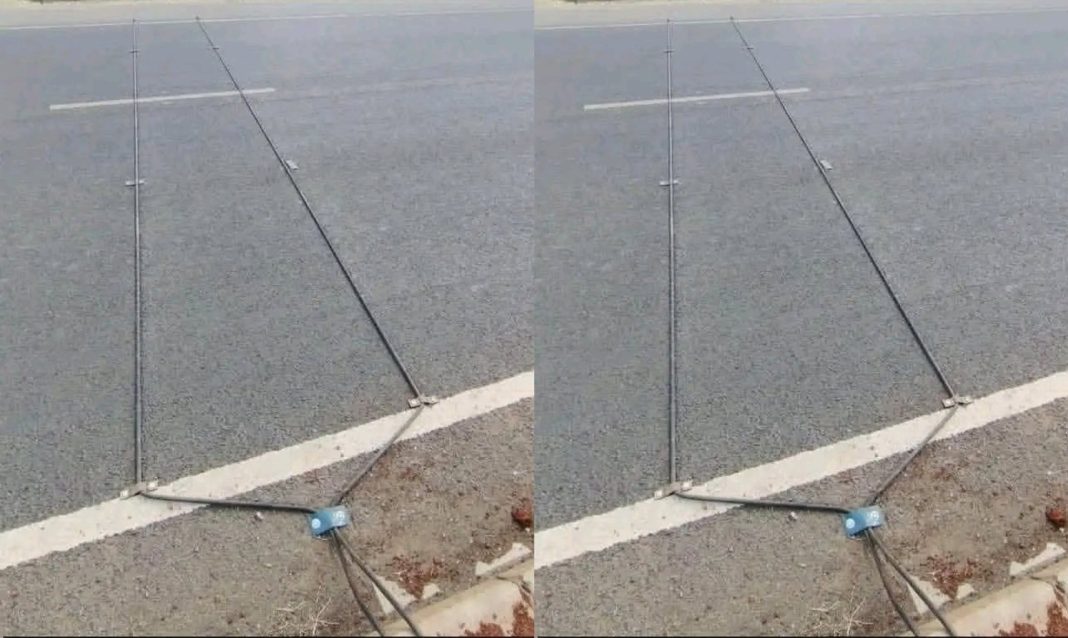

If you’ve driven along Mombasa Road, the Thika Superhighway, or the A104 lately, you’ve probably slowed down for two mysterious black rubber tubes stretched across the tarmac.
Most Kenyan drivers immediately think it’s a new NTSA speed trap or some hidden police gadget meant to catch you off guard. But don’t worry—you aren’t about to get a fine. These are actually called Pneumatic Road Tubes, and they’re basically the ‘census takers’ of the Kenyan highway system.
Here’s why KeNHA is putting them on our roads and what that data is actually used for.
What Exactly Are These Tubes?
Pneumatic road tubes are portable traffic-monitoring sensors. They consist of hollow, flexible rubber tubes laid perpendicular to the flow of traffic. One end is plugged, while the other is connected to a small, weatherproof data-logger box (the “brain”) usually secured to a nearby lamp post or guardrail.
How They Work (The “Air Pulse” Logic)
The technology is simple but remarkably precise. When your vehicle’s tires roll over the tube, they “squish” it. This compression sends a burst (pulse) of air pressure rushing down the tube toward the data logger. An air switch inside the box detects the pulse and converts it into a timestamped digital record.
Why is KeNHA Placing Them on Our Roads?
Agencies like the Kenya National Highways Authority (KeNHA), KURA, and KeRRA use these tubes to gather “Ground Truth” data. This isn’t just about counting cars; it’s about high-level data science for road safety and planning.
Traffic Volume Counting
The most basic function is counting how many vehicles use a specific stretch of road. This data helps engineers decide if a road needs to be expanded from two lanes to four or if a new bypass is required to alleviate congestion.
Vehicle Classification
By analyzing the timing of the pulses, the system can distinguish between a Probox, a 14-seater Matatu, and a heavy-duty semi-trailer. This is crucial for understanding road wear, as heavier axles cause significantly more damage to the pavement than passenger cars.
Speed & Direction Studies
When you see two tubes spaced a few feet apart (like in the photo), the device is measuring speed and direction. The logger calculates the time it takes for a vehicle to hit the first tube versus the second. If the data shows that 90% of drivers are speeding through a specific “Black Spot,” KeNHA might use that evidence to install speed bumps or rumble strips.
There are several misconceptions about these tubes floating around Kenyan social media. While they do record speed data, they are almost never used to issue individual fines. They are for anonymous statistical data. Police enforcement usually relies on hand-held LIDAR guns or permanent CCTV cameras.
These are temporary. Technicians typically leave them out for 24 to 48 hours to get a “snapshot” of a typical day’s traffic before moving them to a different section of the highway.
The rubber is soft and designed to be driven over by everything from motorcycles to 20-ton trucks without causing damage to the vehicle or the road.
Why This Matters for the Kenyan Driver
The data collected by these little black tubes eventually leads to reduced time you spend idling at junctions. Ensuring road repair budgets go to the most heavily used routes. It helps the government plan where new interchanges and flyovers are most needed.