


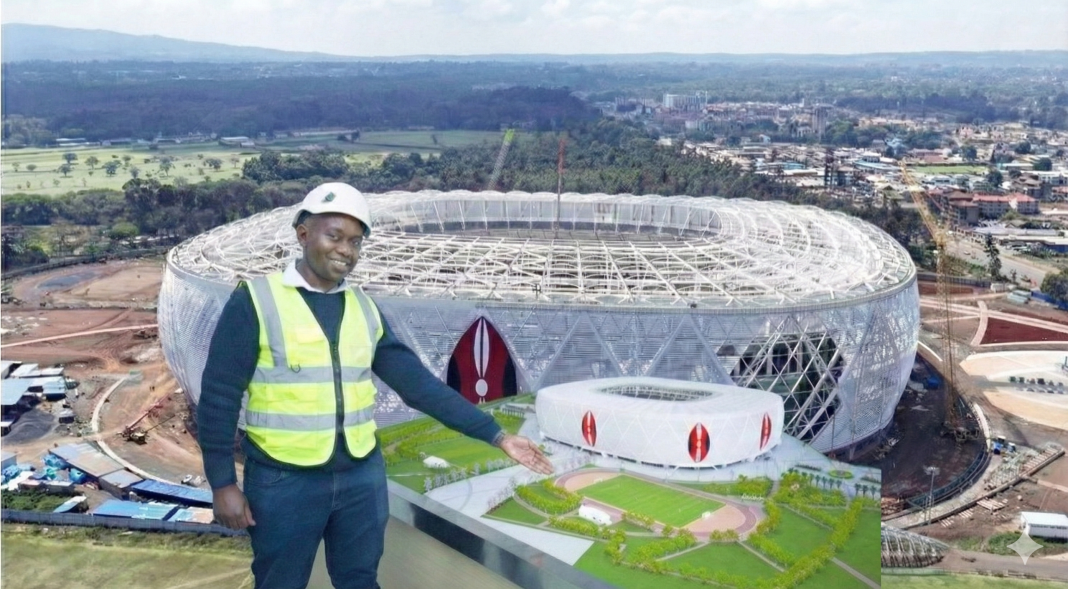

The transformation of the Jamhuri Sports Grounds into the world-class Raila Odinga International Stadium (formerly Talanta Sports City) is a milestone for Kenyan architecture.
While the massive 60,000-seater capacity and the “Shield and Spear” facade grab the headlines, the real story lies in the elite team of designers and the cutting-edge technology companies working behind the scenes to deliver a “smart stadium” by March 2026.
For a project costing KES 45.3 billion, the government moved away from traditional blueprints to create an arena that competes with the likes of the Allianz Arena in Germany.
Who Are the Architects?
The design of the Raila Odinga International Stadium is a hybrid of military precision and academic excellence.
Major Victor King’e (Lead Architect & Project Manager)
Representing the Kenya Defence Forces (KDF) Engineering Department, Major King’e is the mastermind overseeing the technical execution. His role has been to ensure that every concrete pillar and steel cable meets the stringent FIFA and CAF Category 4 requirements.
”The most important thing is to shelter the spectators for their comfort, but the pitch itself will be open to the sky for natural ventilation,” Major King’e noted in a December 2025 progress update.
Professor Erastus Abonyo (Lead Consultant)
The local architectural soul of the project comes from University of Nairobi’s Enterprises and Services Limited (UNES).
Prof. Abonyo, a seasoned architect, was instrumental in ensuring the stadium isn’t just a “concrete bowl” but a cultural monument. He integrated the Maasai Shield motifs into the exterior, turning the stadium into a “Shield of the Nation.”
Companies & Technology Partners
Unlike older stadiums like Kasarani, the Raila Odinga International Stadium is built as a “digital-first” facility. While the China Road and Bridge Corporation (CRBC) is the general contractor, several specialized technology systems are being integrated:
The Media Facade (Lighting)
The stadium features a “Curtain Wall” media facade similar to the Allianz Arena. This allows the entire exterior of the stadium to change colors and display high-definition graphics. This tech is being implemented by specialized lighting subsidiaries under the CRBC umbrella in partnership with international LED giants (often firms like Signify or Leyard).
The Hydraulic Roof System
This is the crown jewel of the project. It is a fully computerized hydraulic tension cable roof-lifting system. Kenya is only the fifth country in the world to use this specific elite engineering. It allows for a lightweight canopy that covers 100% of the seats without the need for heavy, view-obstructing pillars.
VAR & Goal-Line Tech
The interior is being fitted with dedicated VAR (Video Assistant Referee) booths and high-speed fiber-optic infrastructure to support goal-line technology.
These systems are being integrated to FIFA standards, utilizing broadcast tech typical of partners like Hawk-Eye Innovations.
Hybrid Turf (GrassMaster)
The playing surface is not just “grass.” It uses GrassMaster technology—a hybrid of natural Bermuda grass reinforced with synthetic fibers. This ensures the pitch can host back-to-back football and rugby matches (and even concerts) without the turf giving way.
Why the Design Changed
Early renders showed a more generic circular stadium. However, after consultations between the Ministry of Sports and the KDF, the design was “Kenyanized.”
The eight giant shields mounted on the facade are not just for show—they serve as intuitive wayfinding markers. Each shield corresponds to a specific entrance, allowing 60,000 fans to navigate the stadium without getting lost in “signage overload.”
The March 2026 Countdown
With the project currently past the 85% completion mark (as of February 2026), the focus has shifted to the “smart” interiors—the VIP lounges, the high-definition media center, and the automated crowd control systems.
Once the keys are handed over on March 1, 2026, the Raila Odinga International Stadium will not just be a venue for AFCON 2027; it will be a blueprint for the future of African sports infrastructure.