

The Kenyan banking sector is currently undergoing its most aggressive structural shift in over a decade. Driven by sweeping new regulatory mandates from the Central Bank of Kenya (CBK), the landscape of local, family-owned, and mid-tier banks is rapidly giving way to pan-African financial conglomerates.
For institutional investors, corporate executives, and market analysts, the first quarter of 2026 has already delivered two of the largest cross-border banking acquisitions in East African history.
Here is a breakdown of who is buying, who is selling, and the regulatory mechanics forcing the change as compiled by WoK.
The CBK’s KSh 10 Billion Mandate
The trigger for this massive wave of consolidation is the Business Laws (Amendment) Act, 2024. To insulate the economy against macroeconomic shocks and build lenders capable of financing large-scale regional projects, the CBK overhauled the minimum capital requirements for commercial banks.
Speaking to the press in December 2024, CBK Governor Dr. Kamau Thugge didn’t mince words about his desire to see smaller players get eaten up,
“We hope that there will be mergers, and in our view, having stronger banks and a robust capital base will enable them to withstand many other risks, including cybersecurity. This is the new way to have a stronger financial presence in the region, and this can only happen if we have banks with a stronger capital base.”
Historically set at KSh 1 billion, the new law mandates a phased, tenfold increase in core capital. Lenders were required to hit KSh 3 billion by the end of 2025, with the ultimate threshold scaling up to a massive KSh 10 billion by the end of 2029.
Appearing before the parliamentary committee on March 25, 2025, the CBK Governor stated that “The banking sector is facing too many risks, and it needs to have a strong capital base to address and mitigate those risks… banks will gradually increase their core capital to KSh10 billion.”
While Tier-1 banks comfortably absorbed this metric, the new threshold placed an immediate countdown on Tier-2 and Tier-3 lenders: either raise billions in fresh equity, merge with local rivals, or allow foreign capital to take over. Foreign institutions sitting on surplus capital have aggressively chosen the latter.
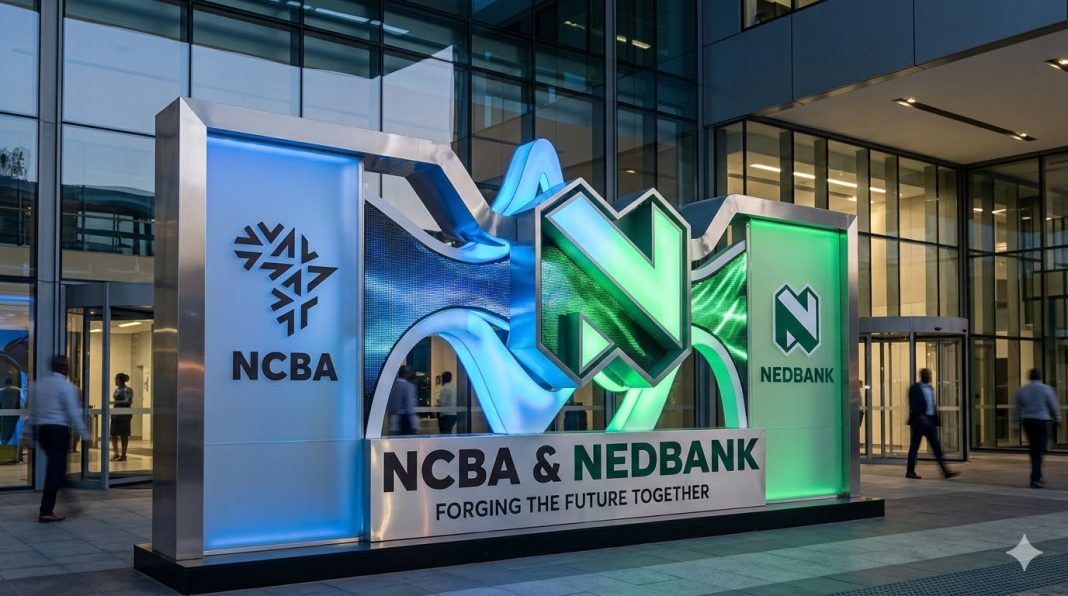
Nedbank’s 66% Takeover of NCBA Group
The most consequential transaction of 2026 thus far is South Africa’s Nedbank Group making a formal move to take control of NCBA Group PLC, Kenya’s third-largest lender by customer base that was under the cusp of the Kenyatta and Ndegwa families.
On January 21, 2026, Nedbank announced a partial pro-rata tender offer to acquire a 66% majority stake in NCBA. The remaining 34% of the bank’s shares will continue to trade publicly on the Nairobi Securities Exchange (NSE), preserving public market participation.
The transaction values the acquisition at approximately Ksh110 billion (Approximately ZAR 13.9 billion or US$855.5 million), pricing the deal at roughly 1.4x book value.
Shareholders tendering their stock are slated to receive a combination of 20% cash and 80% newly issued Nedbank shares listed on the Johannesburg Stock Exchange (JSE).
In February 2026, Kenya’s Capital Markets Authority (CMA) granted Nedbank a critical waiver, allowing the South African giant to execute this partial acquisition without being forced to launch a mandatory takeover offer for 100% of the company.
For Nedbank, acquiring NCBA—an institution that manages roughly KSh 665 billion in assets and disburses over KSh 1 trillion in digital loans annually—provides an immediate, dominant footprint across Kenya, Uganda, Tanzania, and Rwanda.
West African: Zenith Bank Acquires Paramount Bank
Just one day after the Nedbank announcement, the Competition Authority of Kenya (CAK) cleared another landmark transaction: Nigeria’s Zenith Bank PLC acquiring 100% shareholding of Paramount Bank Limited.
Paramount Bank, a niche Tier-3 lender primarily focused on SME lending, had successfully grown its core capital to KSh 3.12 billion by Q3 2025, beating the immediate CBK interim deadline. However, securing the long-term KSh 10 billion requirement necessitated a strategic buyout.
Zenith Bank, dual-listed in Nigeria and London, utilized capital raised from a massive KSh 32.75 Billion (₦351 billion) public offer in 2024 to fund its East African expansion.
To protect local interests, the CAK approved the 100% acquisition with a strict public-interest caveat: Zenith Bank is legally required to retain all 78 of Paramount’s employees for a minimum of 12 months post-completion.
This acquisition solidifies a growing trend. Zenith joins a rapidly expanding roster of Nigerian lenders—including Access Bank, UBA, and GTBank—that are utilizing acquisitions to secure coveted Kenyan banking licenses and establish Nairobi as a central hub for pan-African digital finance.
What to Expect Next
According to CBK data at the close of 2024, nearly two dozen licensed banks were poised to fall short of the ultimate KSh 10 billion mark without intervention.
As the 2029 deadline approaches, the market should anticipate accelerated M&A activity. For corporate investors, the prevailing strategy is clear: the era of the independent, mid-sized Kenyan bank is closing, making way for an ecosystem dominated by heavily capitalized, cross-border financial titans.