
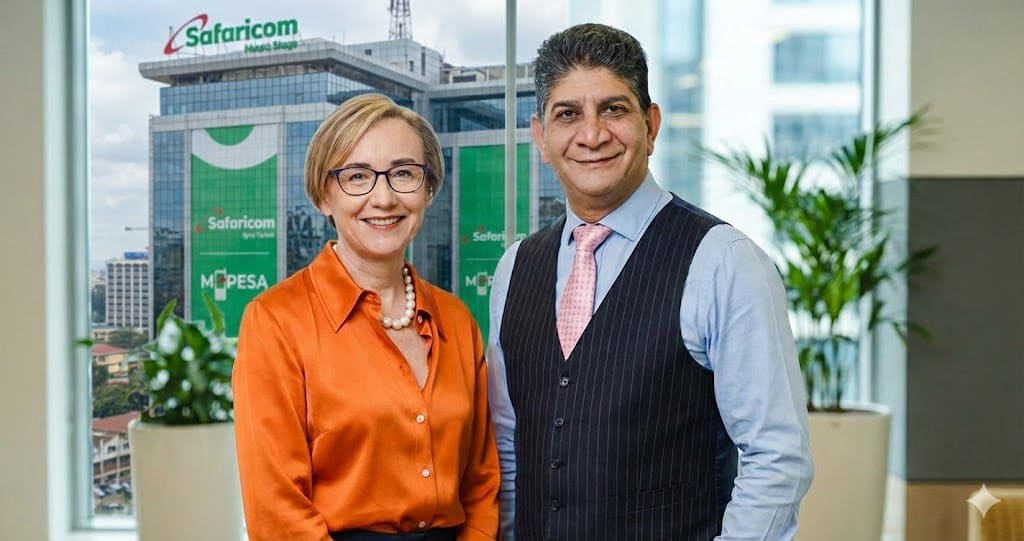

This isn’t just a business deal; it is the “Sale of the Century” for Kenya. While most news outlets are burying the lead in boring financial jargon about “divestiture” and “stake acquisition,” let’s talk about what is actually happening: Majority control of Safaricom—and by extension, M-Pesa—is moving from the Kenyan government to a single foreign entity.
As of February 2026, the deal is in its final, high-voltage stages. The Kenyan government is offloading 15% of its stake to South Africa’s Vodacom for a staggering KSh 244.5 billion. Once the ink dries, Vodacom will own 55% of Safaricom.
But who are the actual people—the billionaires and corporate titans—sitting in London and Johannesburg who will now effectively “own” the platform you use to pay for your morning milk?
Here is what WoK has compiled,
Shameel Joosub (The R73 Million CEO)
If there is one person who has been the architect of this takeover, it is Shameel Joosub, the CEO of Vodacom Group.
- Joosub is a corporate titan who has been with Vodafone/Vodacom since 1994.
- To give you an idea of the league he plays in, his annual salary recently hit R73.5 million (approx. KSh 500 million).
- He doesn’t just run a company; he runs a digital empire that spans South Africa, Egypt, Ethiopia, and now, he holds the “Remote Control” for Kenya’s biggest company.
The London “Iron Lady”: Margherita Della Valle
Vodacom isn’t independent—it is majority-owned by the UK’s Vodafone Group. At the very top of that pyramid sits Margherita Della Valle, the CEO of Vodafone.
- Based in London, she is the one pushing the “Vision 2030” strategy to consolidate African assets.
- The Stake: For her, Safaricom isn’t just a “Kenyan brand”; it is a cash cow that processed KSh 1.6 trillion in monthly deals last year. By consolidating Safaricom into Vodafone’s books, she is making her London-based investors very, very happy.
BlackRock and Vanguard
When you peel back the layers of Vodafone and Vodacom, you find the “Real” owners. These aren’t just individuals; they are the most powerful investment firms on Earth.
- BlackRock & Vanguard: These US-based giants own significant chunks of Vodafone. This means that a tiny portion of every transaction fee you pay on M-Pesa eventually trickles up to the portfolios of billionaires in New York and Pennsylvania.
The “Rupert” Connection
You cannot talk about Vodacom without mentioning the Rupert Family (specifically Johann Rupert, South Africa’s second-richest man). His family’s company, Rembrandt, was a co-founder of Vodacom. While they have diversified over the years, the DNA of the company remains tied to the ultra-wealthy elite of Southern Africa.
A Section of Kenyans unhappy
This deal hasn’t gone down without a fight. In Nyeri and Nakuru, public participation forums have been heated. Residents are asking a simple but chilling question: “If a foreign company owns M-Pesa, who owns our data?”
Even more dramatic is the legal battle. Activists like Tony Gachoka and Fredrick Ogola have moved to the High Court to stop the sale. Their argument? The government is selling Safaricom at KSh 34 per share, but they claim the “real” value—given Safaricom’s monopoly and data assets—is closer to KSh 70 or KSh 80.
What Changes for Kenyans?
The government says your M-Pesa won’t change. They’ve promised that the CEO and Chairman will remain Kenyan. But let’s be real: The person who owns 55% of the shares calls the shots.
When Safaricom makes billions in profit next year, 55% of those dividends will no longer stay in the National Treasury to build our roads or pay our doctors. Instead, they will be converted into Dollars and Rands and shipped off to Johannesburg and London.
| Shareholder | Old Stake | New Stake (2026) | Origin |
| Vodacom Group | 35% | 55% (Majority) | South Africa/UK |
| Government of Kenya | 35% | 20% | Kenya |
| Public Investors | 25% | 25% | Global/Local |
| Vodafone Group (UK) | 5% | 0% (Folded into Vodacom) | UK |